This field note was inspired by my holiday reading of Julian Montague’s The Stray Shopping Carts of Eastern North America: A Guide to Field Identification.
Winner of Diagram/Bookseller prize for The Oddest Book Title of 2006, the recently expanded and revised conceptual art project approaches abandoned shopping carts as artifacts rather than refuse.
The book presents a rigorous and deliberately dry taxonomy for identifying and cataloging stray carts according to condition, displacement, and mode of resituation. Spanning more than thirty categories, from damaged and fragment carts to plaza drift and plow crush, Montague’s project is as methodical as it is absurd. Through careful documentation and classification, it offers a way of seeing the built and natural worlds, and our interactions with them, from an unexpected and often disarming perspective.
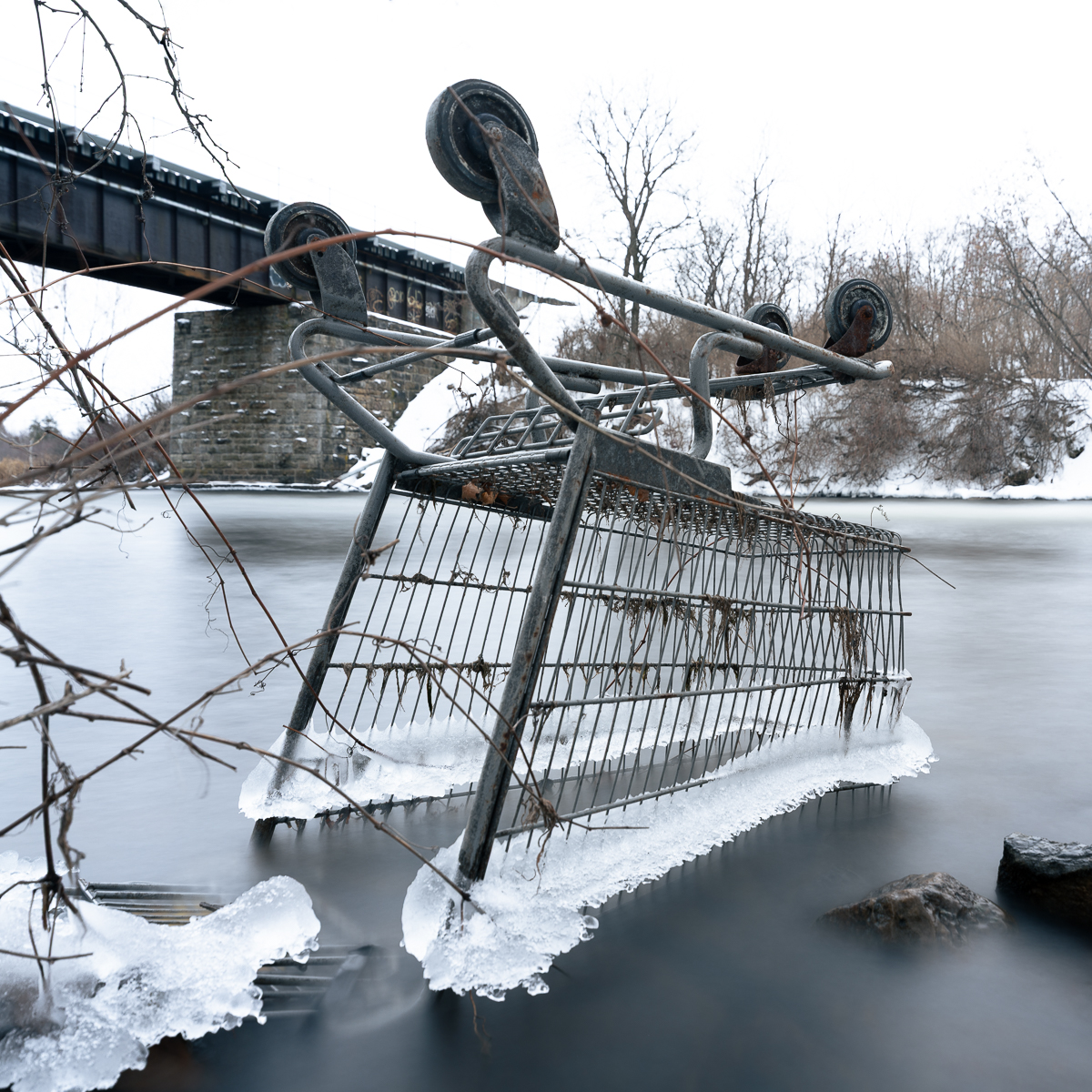
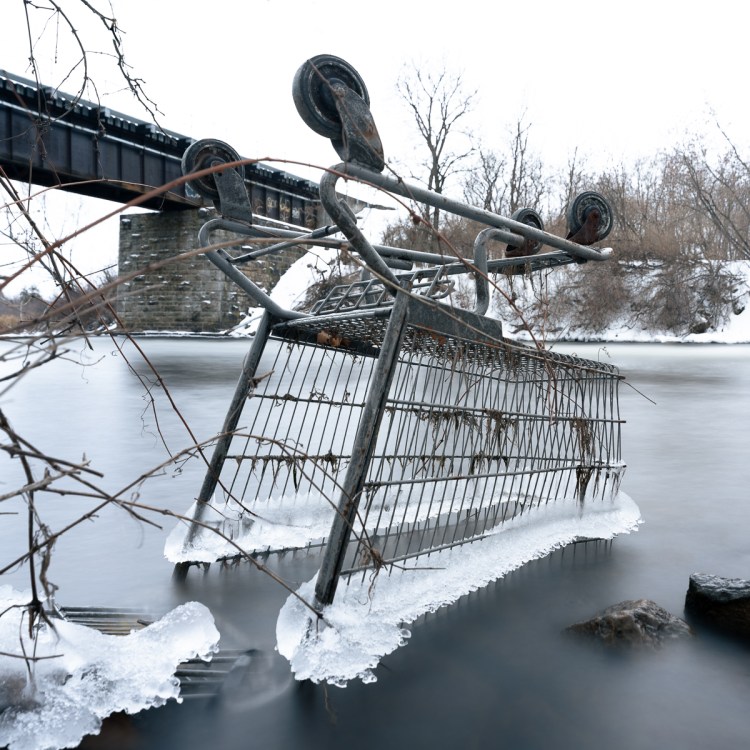
I encountered this particular cart while exploring new territory for my Meditations on the Rideau project. Lying upside down at the boundary between river and shore, its wire frame was interwoven with vegetative growth, its lower rails partially shrouded by ice. A long exposure reduced the moving water to a continuous surface, contrasting with the cart’s fixed and rigid form.
In the terms outlined by Montague, this cart would be classified as a Class B True Stray, an object that will not return to the source from which it originated. Located beyond the base of a waterfall, it was likely thrown from an adjacent bridge over the safety railing. With no business that uses shopping carts within a kilometre, I assessed Type 13 Complex Vandalism, based on the degree of effort required to resituate the cart. Having then been carried downstream by the waterfall and river current, it also meets the criteria for Type 21 Naturalization, resulting in a specimen designation of B/13•B/21.
We so often idealize our landscape photography that it can feel strange to notice, and even acknowledge, these discarded artifacts. Yet they persist, migrating through systems not meant to carry them, becoming transient markers of human presence within a larger and ongoing environment.
 Scott Murphy – Photographer