
Meditations on the Rideau – Field Note 001
A quiet afternoon at Jones Falls on the Rideau Canal during the season’s first snowfall. I enjoy this time of year for photography when fresh snow covers the ground but the water remains open. It’s a rare opportunity to catch snow-shrouded reflections, and I’ve not taken full advantage often enough.
Two long exposures, upstream and downstream, made with a wooden 4×5 pinhole camera. Ninety seconds each. Enough time for wind and water to blur and soften the scene.

4×5 pinhole, Ondu 4×5” Easy, Ilford Delta 100, 90s.
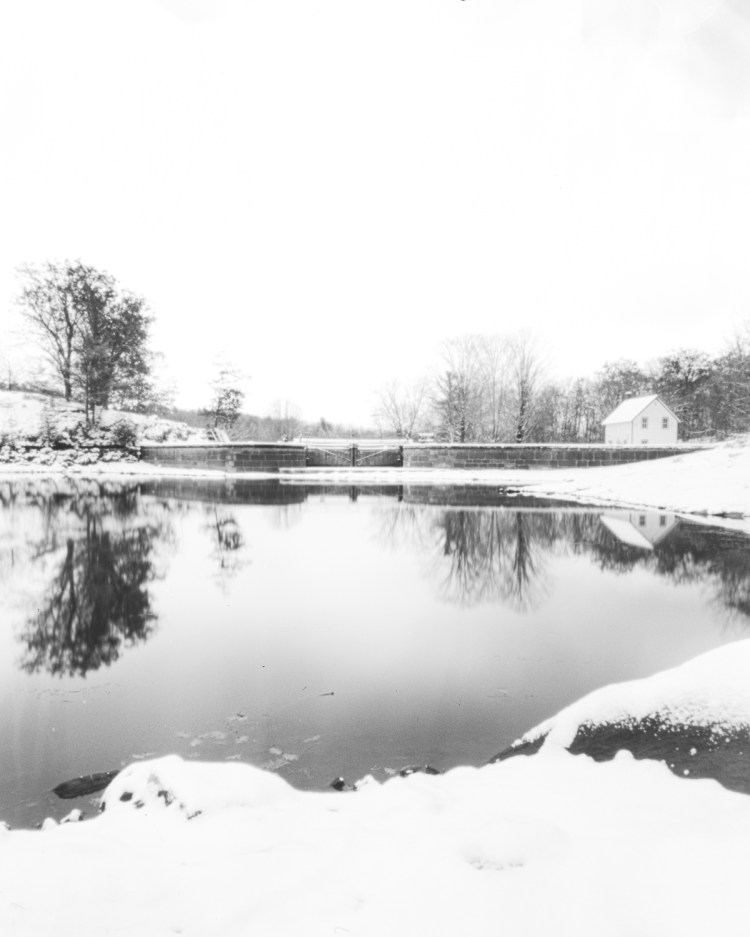
4×5 pinhole, Ondu 4×5” Easy, Ilford Delta 100, 90s.
After the film exposures, I made a different medium format image from the same position. Same tripod holes in the snow. Same cold footing. Simply a different way of recording the moment. Medium format resolution offers higher clarity. Shadow and snow separate cleanly across a wide dynamic range. Detail appears with near-forensic precision. The landscape was already leaning into monochrome, so I converted this version to black and white to match the light.

Hasselblad X2D II 100C, XCD 4/28P, ISO 50, f/8, 1/4 s, converted to B&W.
I move between these modes: the measured uncertainty of pinhole film and the precision of digital capture. Light touches both film and sensor, but the results differ. As Garry Winogrand notes, “Photography is not about the thing photographed. It is about how that thing looks photographed.” On film, the image retains a direct physical index of light on material, while the digital file becomes an interpretation shaped through algorithm. One records how the moment felt. The other shows how the place might be understood. Both begin in reality. Each arrives there in its own way.
 Scott Murphy – Photographer