
This week, we explored photographic ethics, focusing on how we, as photographers, responsibly capture, edit, and distribute images. We have a certain power as photographers: taking a photograph confers importance on the subject, implying significance to the person behind the lens. However, this act can also suggest that the subject is different, exotic, or represents the ‘Other’ to the photographer and (likely) their audience. Even well-intentioned photographers can inadvertently perpetuate stereotypes that misrepresent people and places.
We must address moral and ethical questions in our methodologies and research to maintain an ethical, accountable practice. Our reading introduced the concept of the ‘ethical triangle,’ highlighting the interconnectivity between the subject, the photographer, and the audience.
Author – Subject – Audience
The degree to which we ‘own’ our likeness varies by jurisdiction and by use. In the UK, for example, anyone can be legally photographed in public without permission or awareness. However, individuals have rights concerning how those images are used commercially to endorse a product or service. This issue becomes even more sensitive when the subject is a minor or a vulnerable adult, as they often lack the legal right to grant consent.
In my previous work as an amateur photographer, I did not have an audience, so the triangle model was less applicable. Moving forward, though, I believe my current methodology considers the balance of power between author, subject, and audience, keeping them in equilibrium.
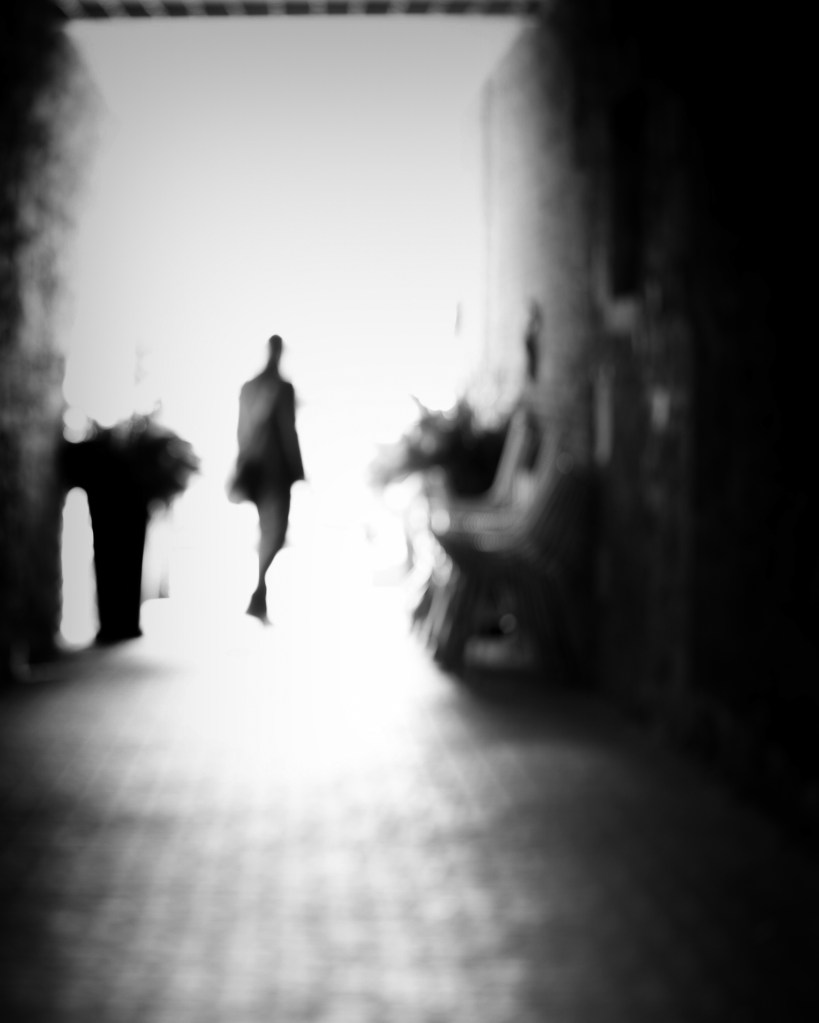
My “people photography” is typically autobiographical or shot in a manner that leaves the subject anonymous. My methods include silhouetting, shooting from a distance with a wide-angle lens to diminish the subject and enlarge the environment, shooting long exposures that blur the subject, and deliberately out-of-focus shots. My preference for black and white photography further abstracts human subjects by highlighting light and shadow, emphasizing shape and form, and focusing on tonal range and emotional impact. This approach aims to preserve the subject’s privacy while allowing me to explore themes of isolation and alienation and express them in a dystopian aesthetic.

There have been earlier times when I felt I was shooting in a grey area. For example, the photo below was taken at the Quebec City Hall fountain installation. I was photographing the illuminated water jets when a group of children ran into the scene and began to play. I took a couple of shots, capturing an expression of unadulterated joy (which I’ve largely hidden under a superimposed block to obscure the person’s identity). Despite my documentary intentions, I felt uncomfortable taking pictures of children and consequently I put my camera away and moved on so they could enjoy their play.

This experience prompted me to consider how to make unposed natural street photography that explores the human condition without exploiting the subject and their privacy. This led to my currently methodology, which I will continue to evolve through research and practice. I believe there is value in documenting the scenes and moments of our time, and that we can do so respectfully.
Figures
Figure 1: Scott MURPHY 2022. Self. Private collection: Scott Murphy.
Figure 2: Scott MURPHY. 2024. Pause. Private collection: Scott Murphy.
Figure 3: Scott MURPHY. 2021. Children playing in Quebec City Hall foundation. Photograph by the author, 12 August 2021
 Scott Murphy – Photographer