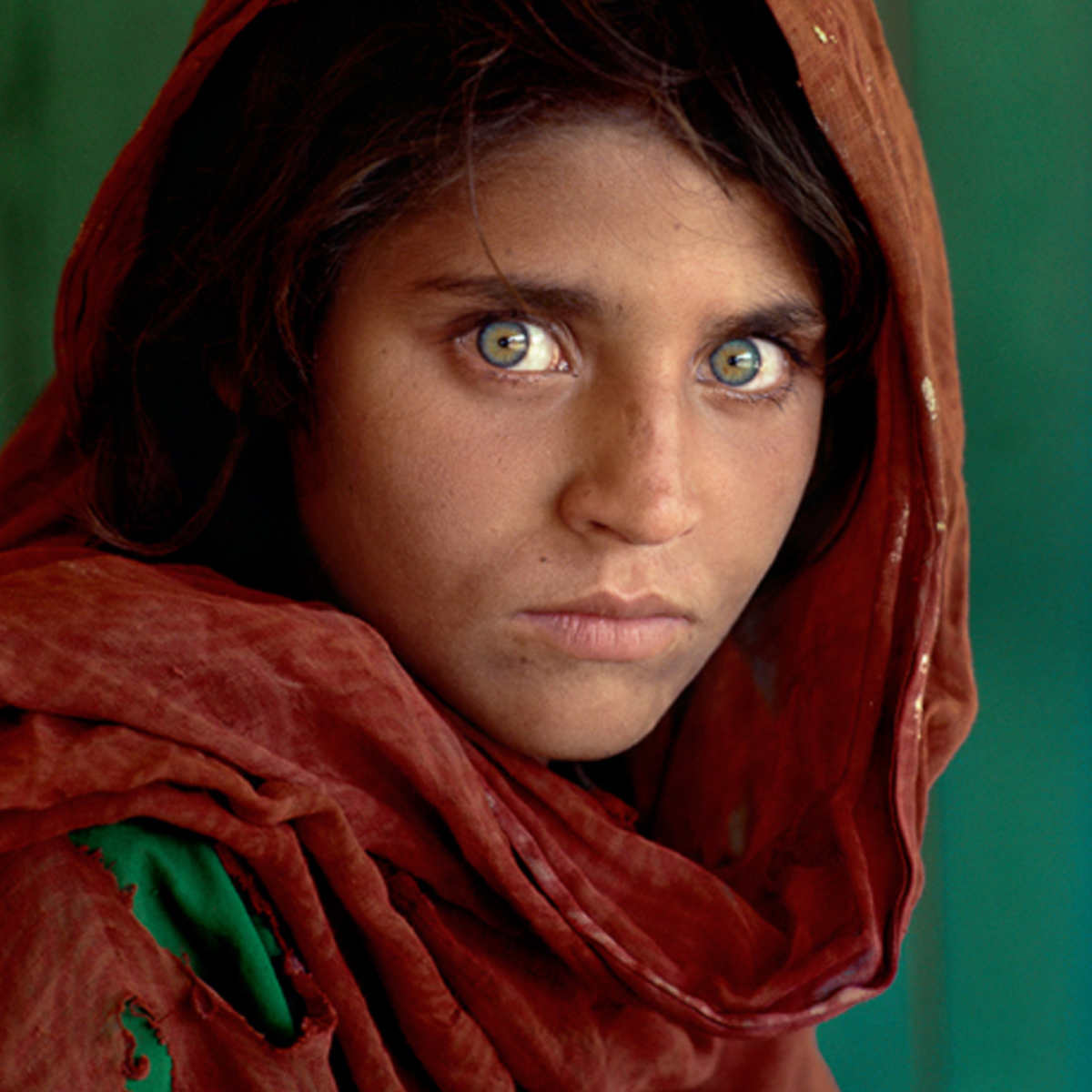
This week we engaged in reading photographs, in analyzing and interpreting the visual elements, historical/cultural contexts, and underlying meanings within an image.
This act goes beyond simply looking at an image, as it involves considering it from a number of different perspectives.
Among other methods, such as those based on Barthes’ concept of studium and punctum, our assigned reading Visual Analysis by Paul Martin Lester listed 13 discrete steps:
Inventory: Make a list of all you see in the picture.
Composition: Notice the pictures elements and how they are arranged. Do they contribute to, or distract from the picture as a whole?
Visual Cues: Study the use of colour, form, depth, and movement within the image. Look for the source and direction of light in the picture. Is it artificial or natural, cool or warm, hard or soft?
Semiotic Signs and Codes: What iconic and symbolic signs can be identified?
Cognitive Elements: How does knowledge, culture, et al contribute to the image’s understanding?
Purpose of the Work: What is the image’s purpose – news, art, scientific, personal snapshot, or other?
Image Aesthetics: What makes the image compelling to look at? Are there formal and/or creative elements that make it beautiful?
Personal Perspective: What is the quick impression upon first viewing?
Historical Perspective: When was the image made? What major developments were happening in the area at that time? Is a specific art style being imitated?
Technical Perspective: How did the producer generate the image? Does this contribute to the meaning or purpose of the work? Are production values high or low?
Ethical Perspective: Did making the image cause unjust harm?
Cultural Perspective: Which symbols and metaphors are used, and what is their meaning for a society as a whole ( consider the photographers culture, as well as the subject’s )?
Critical Perspective: What conclusions can be drawn about the medium and culture from which the image is produced? How does knowledge about the medium, the practitioner, and the image produced change your perspective? How is the image respected or rejected by society?
We put this approach to practice in both our weekly seminar and online discussion activity. For the latter, we considered two examples of portraits of young Afghan women.
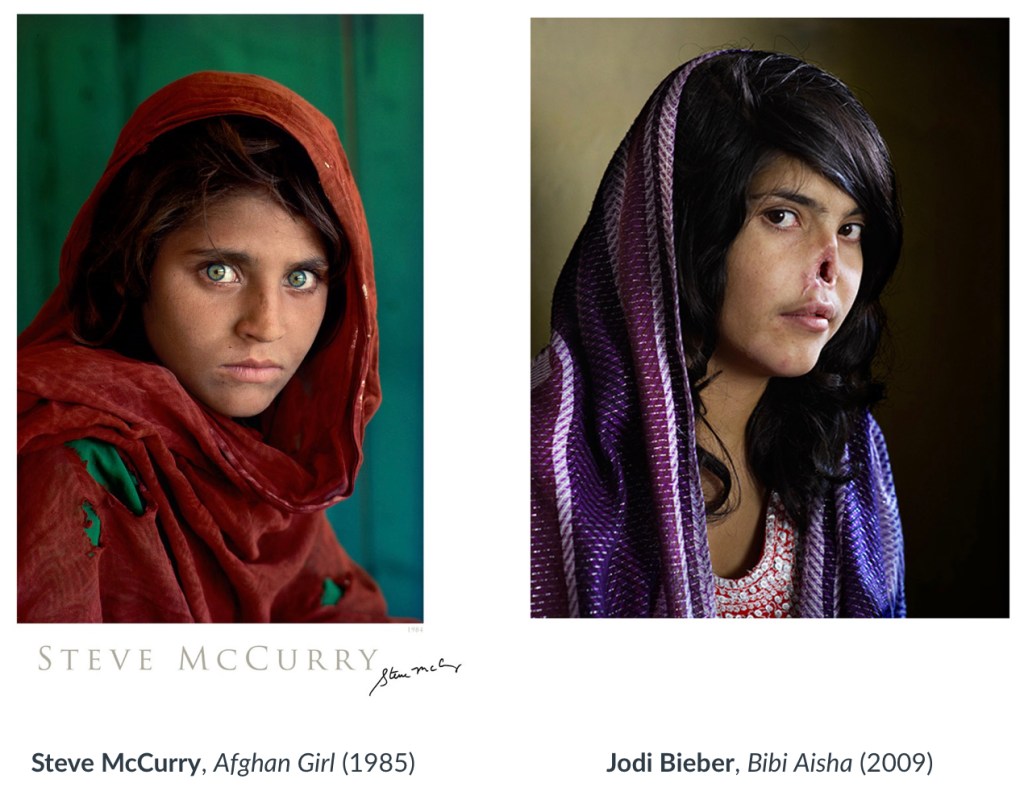
On the left is Steve McCurry’s portrait Afghan Girl, the iconic National Geographic cover photo. Taken at an all-girls Islamic religious school, the portrait features twelve-year-old student Sharbat Gula. I was superficially familiar with the photo, however, learning the context behind its making changed my appreciation for it (and not for the better).
McCurry had spotted her striking green eyes upon entering the classroom, and had a teacher move her in front of a complementary background to pose. The resulting portrait, which was captioned “Haunted eyes tell of an Afghan refugee’s fears”, became one of the world’s most recognized.
Only in 2002 did Sharbat reveal her emotions at the time: not so much fear, as anger. Anger at the violation of traditional Pashtun norms by coercing her reveal her face, interact closely and establish eye contact with, and be photographed by a man outside her family circle.
The portrait Afghan Girl ( McCurry had not learned her name ) went on to generate substantial profits, with Sharbat Gula receiving none of the proceeds. As noted by Tala Ahmadi when addressing the hidden truth behind the image, it’s ironic that a photo purported to highlight the plight of refugees saw the Western photographer reap the riches from the image for himself.
In contrast, Jodi Bieber’s portrait of Bibi Aisha was commissioned for Time Magazine for a feature highlighting the Taliban’s atrocities endured by the Afghan people. Eighteen-year-old Bibi Aisha, who had been maimed by her Taliban husband, collaborated with Bieber to share her horrific experience of patriarchal violence. Given the high risk of retribution, Time ensured that Aisha was secured in a guarded secret location prior to publishing her portrait as a cover image, and then later supported her reconstruction surgery in the United States.
Similar images, dissimilar approaches.
This exercise challenged my views on iconic images. Without knowing the photographer’s intention and/or methodology behind the image, and the degree to which the subject collaborated, how well can we truly understand the image? What can be taken at face value, and what cannot? Knowing now of these questions, how do we adjust our own photographic practice?
Bibliography
AHMADI, Tala. 2023. ‘The Boar’. 2024. [online]. Available at: https://theboar.org/2023/12/the-hidden-truth-behind-the-infamous-national-geographic-afghan-girl-photo/ [accessed 21 Jun 2024].
KARNAD, Ribhu and Raghu. 2019. ‘You’ll Never See the Iconic Photo of the “Afghan Girl” the Same Way Again’. 2024. The Wire [online]. Available at: https://thewire.in/media/afghan-girl-steve-mccurry-national-geographic [accessed 18 Jun 2024].
LESTER, Paul Martin. ‘Visual Analysis :: Visual Communication; Images with Messages’. 2024. [online]. Available at: https://content.talisaspire.com/falmouth/bundles/5fc6678d9faa880fc7372314 [accessed 21 Jun 2024].
STENGEL, Richard. 2010. ‘The Plight of Afghan Women: A Disturbing Picture’. TIME [online]. Available at: https://time.com/archive/6597397/the-plight-of-afghan-women-a-disturbing-picture/ [accessed 21 Jun 2024].
‘Topic 4: READING PHOTOGRAPHS: Activity’. 2024. [online]. Available at: https://flex.falmouth.ac.uk/courses/1311/discussion_topics/31568?module_item_id=70225 [accessed 21 Jun 2024].
‘Topic 4: READING PHOTOGRAPHS: Presentation: Positions and Practice PHO710 23/24 Part-Time Study Block S3’. 2024. [online]. Available at: https://flex.falmouth.ac.uk/courses/1311/pages/topic-4-reading-photographs-presentation?module_item_id=70224 [accessed 21 Jun 2024].
WALKER, John A & EVANS, Jessica. ‘Context as a Determinant of Photographic Meaning :: The Camerawork Essays; Context and Meaning in Photography’. 2024. [online]. Available at: https://content.talisaspire.com/falmouth/bundles/5fc6676347e6434ce33a1b84 [accessed 21 Jun 2024].
Figure
Figure 1. Steve MCCURRY. 1985. Afghan Girl and Jodi BIEBER. 2009. Bibi Aisha. Available at: ‘Topic: Topic 4: READING PHOTOGRAPHS: Activity’. 2024. [online]. Available at: https://flex.falmouth.ac.uk/courses/1311/discussion_topics/31568?module_item_id=70225 [accessed 21 Jun 2024].
 Scott Murphy – Photographer